Thursday, November 29, 2012

Messenger spacecraft detect polar ice at Mercury

The blazing hot surface of Mercury, 400 degrees Celsius during the day, might seen an unusual place to find water ice. But nighttime temperatures drop well below freezing, and that planet also has no axial tilt so the Sun is always above that planet's equator and thus is very low on the sky when viewed from the planet's north or south poles. Which means that the bottoms of deep craters near the poles are permanently shadowed and never see any sunlight, and thus are very cold. Cold enough to cause any water vapor there to freeze out at the bottom of these craters. But Mercury is airless and waterless, so there should be no ice there, right? Except for when an icy comet happens to impact the planet, which would create a hot plume of water vapor, most of which will escape the planet. But a tiny fraction of that escaping vapor will find its way to the polar craters where it freezes out, so these polar craters are slowly accumulating cometary water ice over time. This expectation was recently confirmed by the Messenger orbiter at Mercury, which detected changes in the flux of neutrons from the planet's surface that is consistent with patches of water ice at the bottoms of these polar crater. Red areas in the above image of Mercury's north pole are the permanently shadowed regions, and yellow indicates where Earth-based radar imaging of this planet showed likely sites of water-ice deposits. For more information, visit the Messenger website for additional details.

Wednesday, July 25, 2012

Another fantastic Space Station video

Follow this link to see another fantastic video of Space Station hardware in orbit above an amazing planet Earth. This movie was assembled by Knate Myers using video clips posted online by NASA's Earth Sciences and Image Analysis office.

Wednesday, July 18, 2012

Amazing video of atmospheric lights seen from ISS

Follow this link to see a truly amazing video showing all sorts of atmospheric lighting that is seen by the astronauts onboard the International Space Station: aurora, lightning, city lights, and background stars rising through Earth's atmosphere. This must-see movie was assembled by Alex Rivest using video acquired by astronaut Don Petit; see Alex's blog for more details.

Wednesday, January 4, 2012

Dusty planetesimal ring orbiting star HR 4796 A

This image of a circumstellar dust ring was recently acquired by C. Thalmann and colleagues at the 8 meter Subaru telescope that the Japanese operate on the summit of mount Mauna Kea in Hawaii. Although the dust ring is nearly circular, the line-of-sight to the ring is oblique which makes the ring appear elongated. To reveal the faint ring, the astronomers must subtract a model image of the very bright central star, but imperfections in the star-subtraction results in the radial residuals seen in the image. Nonetheless the dust ring is still quite prominent despite those residuals, and its radius is about 80 AU. This dust is thought to be the result of collisions occurring among unseen planetesimals also orbiting within the ring. These planetesimals probably resemble the comets that inhabit our Kuiper Belt, which is the Sun's outermost debris belt that is of radius 45 AU. Another interesting feature of this image is that the dust ring's center is offset slightly from the star. Although the origin of this offset is uncertain, an unseen extra-solar planet is implicated, because its gravitational influence can displace the ring's center. But if there is an exoplanet here, it is too faint to be seen or is obscured by the residual starlight. For more information about this circumstellar dust ring, see this press release.

Wednesday, November 30, 2011

Planet formation and destruction via gravitational instability

This graphic shows a computer simulation of a circumstellar disk that orbits a young star, with each snapshot showing the state of the disk 1,500 years later. This disk is gravitationally unstable, which means that the disk's gravitational attraction for itself causes material to contract into spirals that can also clump up further to form Jupiter-mass protoplanets. The black circles in the above (click picture to zoom in) follow one such clump that first forms at a distance of 300 AU (ie 300 times the Sun-Earth distance) from the central star, which then spirals inwards due to its interactions with the disk. This simulation illustrates one of the difficulties in forming giant planets via gravitational instability, since the clumps that do form by this process also tend to get driven inwards by the disk, where they might accrete onto the central star. For additional details, see the preprint by Zhu and colleagues.

Friday, October 21, 2011

Spiral arms in disk suggests unseen planets

This image of the disk that is in orbit about the young star SAO 206462 suggests that this disk might be perturbed by one or more unseen planets. This image was acquired at the Japenese Subaru telescope in Hawaii by Carol Grady (Eureka Scientific). In this image, the central star is deliberately masked by the telescope's optics, which revealing a broad disk of gas and dust in orbit about the star. The size of this disk is at least twice the diameter of our Solar System. Planets are known to form in these circumstellar disks, and computer simulations of this process show that a young giant planet can also launch spiral density waves in such a disk. So this disk's spiral appearance does suggest that giant planets may have formed here. But keep in mind that this is not the only explanation. For instance, the gravity of passing star can also disturb a disk, and such a disturbance would wind-up over time and also resemble a spiral. But further study of this system may one day reveal whether the disk at SAO 206462 is indeed planet forming. See this press release for more details.

Thursday, October 13, 2011

Vesta's rugged surface

This image is a computerized rendering of what a hypothetical observer migth see when looking obliquely along the mountains and craters on the giant asteroid Vesta. Of course the Dawn spacecraft is in orbit about Vesta, and thus is always looking down upon the asteroid, so Dawn would never see anything like this. But Dawn has now collected enough measurements of Vesta surface topography to assemble a detailed computer model of the asteroid's surface. With that model, one can then calculate the view that any observer might see when looking in any direction about Vesta. Keep in mind that Vesta is only about 700 miles across, so the more distance mountains shown here would not be seen by that observer; they'd lie below the horizon and thus would be hidden. But that computerized view can be adjusted to remove the asteroid's curvature (ie, flatten the asteroid) while preserving its topography, as is seen here. See the Dawn website for more details about this computerized image of Vesta's rugged surface.

Sunday, September 18, 2011

Four fascinating videos on science and math

Last week I was in a working meeting with a number of planetary scientists. When there was a lull in the meeting, I asked everybody to show me their favorite online science videos. Below are the best four, and all are quite remarkable.

The first is called Doodling in Math Class: Snakes and Graphs. This amazing video is by Vi Hart, and she shows how to sketch elaborate doodles that have a mathematical theme. The very clever (and funny) commentary provides tip on how to draw, plus some hints about the mathematics that are associated with each sketch.

The second is a 50 minute video by Astronaut Don Petit, who recorded several of the fluid-dynamics experiments that he performed while in the microgravity environment of the Space Station; see this youtube video. One interesting clip shows an air bubble that he creates inside a floating water bubble, which to me resembles a miniature planet that has a central core and an overlying mantle. He then injects little water bubbles into the air core, which careen around and around the core boundary until getting absorbed explosively by the mantle. Another video segment show how small bodies in the weightless environment of space can collide, merge, and form elaborate dendritic objects. This is in fact how planetesimals, which are the precursors to asteroids and planets, are thought to have formed. A fascinating video.

The next two videos are from the Slo Mo Guys. They use a high-speed camera to record ordinary events that are usually just a blur. Playing their movies very slowly then reveals lots of hidden events that are too fast to be seen by human eyes. In the first video, Giant 6ft Water Balloon, one of the Slo Mo guys leaps onto and breaks a large water-filled balloon. Slow motion video reveals how the entire balloon shivers as inertial waves propagate across the balloon and ultimately rip the balloon to shreds. In very cool slow mo.

But my favorite movie is Droplet Collisions at 5000fps, which provides an excellent analogy for how craters form and develop when an asteroid impacts a planet. Oh, and the Slo Mo guys are hilarious, too.

Tuesday, September 6, 2011

Earth's first Trojan asteroid

Earth's first trojan asteroid was recently detected by Martin Conners (Athabasca University) and colleagues using NASA's WISE satellite, which is surveying the sky at infrared wavelengths. Trojans are asteroids that reside in or near two sites that lead or trail a planet's orbit by 60 degrees, and these orbits are stablized by the combined gravities of the Sun, the planet, plus the centrifugal force that is due to the asteroid's orbital motion. This particular asteroid is known at 2010 TK7, and it is small, maybe a half mile across. This Trojan is indicated by the small white dot in the above graphic. The blue dots show the Earth's motion about the Sun, while the green dots show that 2010 TK7's motion can carry it quite far from the stable equilibrium site at 60 degrees, which is also known at the L4 Lagrange point. Indeed, orbit calculations by Paul Wiegert (University of Western Ontario) show that this is only a temporary Trojan, since Earth captured that object at its L4 point about 1500 years ago, and it will probably escape back into interplanetary space in a comparable amount of time. See Wiegert's very nice website on 2010 TK7 for more details.

Friday, August 26, 2011

A pulsar planet with a diamond core?

PSR J1719−1438 is a pulsar, which is a rapidly spinning neutron star. Such an object is called a pulsar because its powerful magnetic field shoot jets of energetic particles out along its magnetic poles. This also makes the spinning neutron star appear to pulse as its jet sweeps past an astronomer on Earth.

Slight variations in the timing of the neutron star's pulses can indicate the presence of an unseen planet that is also orbiting the pulsar. Indeed, the first known extra-solar planet was discovered via pulsar timing variations. Matthew Bailes (Swinbourne University in Australia) discovered the timing variations in pulsar PSR J1719−1438, and they are due to a Jupiter-mass planet in a very close two-hour orbit about the neutron star. He and his colleagues also show that this planet must be very small and dense to avoid having been ripped apart by the neutron star's gravitational tide. This planet's minimum density is about 20 times that of Jupiter's, and the planet's core is likely made of carbon. If so, then carbon at the center of this very dense planet will have crystallized, possibly into one giant planetary core-sized diamond. See this press release for more details.

Saturday, August 13, 2011

Streaks at Martian crater suggest a watery flow

This is the upper edge of the Newton crater on Mars, imaged my the Mars Reconnaissance Orbiter (MRO). The dark streaks extending downslope are very interesting; they are only seen in spring and summer, and fade away during the colder seasons. These streaks might be due to a flow of subsurface water that is likely a salty brine due to long-term contact with the martian rocks. Salt lowers the freezing point, which might allow subsurface ice to melt and seep down the crater's slope. This might be the cause for the seasonal stains that are seen in the crater's soil. Additional details can be found at the MRO website, including this nice movie of streaks forming and then fading. If these streaks are in fact watery seeps, they will be of great biological interest because wet soil will be a natural place to look for microbial life on Mars.

Monday, August 1, 2011

Vesta is groovy

The giant asteroid Vesta, as seen by the Dawn spacecraft, which has been orbiting Vesta since July 15. See the Dawn website for more information. This movie of Vesta's rotation is also interesting...evidently, Vesta is quite `groovy'.

Friday, July 22, 2011

Last shuttle re-entry, as seen from Space Station
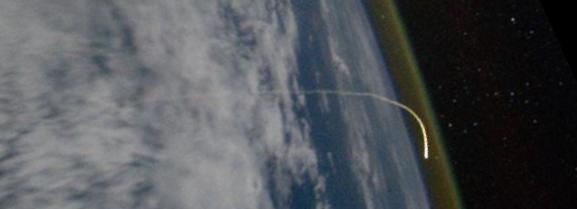
Shuttle Atlantis' final return to Earth, as seen from the International Space Station. This picture comes from the NASA Image of the Day.

Wednesday, July 20, 2011

Hubble finds new moon orbiting Pluto

Mark Showalter (SETI Institute) just discovered a fourth moon orbiting Pluto, designated P4 for now. It is quite small, about 15 miles across, and its orbit resides between satellites Nix and Hydra. This discovery was quite accidental, because Showalter was observing the Pluto system to look for signs of any planetary rings there; see the Hubble website for more details. Since Pluto seems ripe with satellites, we might expect the New Horizons spacecraft, which flies by Pluto in 2015, to find even more tiny satellites.

Friday, July 15, 2011

Dawn spacecraft to orbit Vesta tonight!

The Dawn spacecraft goes into orbit about the giant asteroid Vesta tonight, July 15, about 10pm Pacific time or 1am Eastern time July 16. See the Dawn website for more.

Wednesday, July 6, 2011

Cassini monitors monstor storm on Saturn

Cassini snapped this picture of a monster storm on Saturn on Feb. 25, 2011. This storm started in December 2010, and has since wrapped itself all the way around the planet, spanning an area about 8 times that of the Earth's total surface. The thin dark band at the equator is Saturn's rings seen edge on, and the broader dark bands below are the shadows cast by the rings.

The image below is color coded to indicate the altitude of the various cloud layers in the storm. Blue, white, and yellow indicate clouds at higher altitudes, with green, red, and brown colors showing clouds that are deeper in this gas giant planet's atmosphere. Check the CICLOPS website for more information and Cassini images of Saturn.

Saturday, July 2, 2011

Dawn gets closer Vesta

The Dawn spacecraft's view of Vesta's rugged surface gets a little sharper as the spacecraft approaches this very large asteroid. Dawn is still 100,000 miles away from Vesta, but it arrives and goes into orbit about that giant asteroid soon on July 16! Meanwhile, keep an eye on the Dawn website for the latest images that will get more dramatic over time as the spacecraft nears.

Thursday, June 30, 2011

Helene at Saturn

The Cassini spacecraft captured this closeup image of Helene on June 18, 2011. Helene is a small satellite of Saturn about 20 miles across. Helene is a coorbital satellite, which means that it shares an orbit with the much larger satellite Dione that is ~30 times larger and ~30,000 times more massive. Helene resides at Dione's L4 Lagrange point, which is a stable niche in Dione's orbit that leads that satellite by 60 degrees. The other stable niche is of course the L5 Lagrange point that trails Dione by 60 degrees. The orbit of a coorbital satellite is analogous to the Trojan asteroids that lead or trail Jupiter by 60 degrees in its orbit about the Sun.

No one knows how a coorbital satellite like Helene came to reside in such a special orbit. But it is conceivable that a coorbital satellite is debris that was excavated when the larger satellite Dione was stuck by a comet long ago. If this scenario is correct, then a lucky fraction of that debris managed to find and settle into one or both Lagrange points where it could have reassembled into a small coorbital satellite like Helene.

To see more images of Helene, as well as the rest of the Saturnian system, visit Cassini's CICLOPS website.

Monday, June 13, 2011

The Dawn spacecraft approaches asteroid Vesta

The is the Dawn spacecraft's view of the asteroid Vesta. Dawn is the NASA mission that will visit two asteroids, beginning with Vesta in a few weeks, and then Ceres in 2015. Dawn will go into orbit about Vesta on July 16 to study that asteroid's surface for about a year. Vesta is about 300 miles across and is the fourth largest asteroid. Vesta's surface is composed of basaltic rock, or lava, which makes this asteroid quite unique and very interesting. Evidently Vesta was volcanically active in the past, likely when it first formed 4.5 billion years ago.

In July 2012, Dawn will then fire up its ion engine and depart Vesta for its 3 year trip to asteroid Ceres, which is the largest asteroid, one that appears to be quite rich in water. Meanwhile, keep an eye on the Dawn mission website for better pictures of Vesta that will soon get much more interesting when the spacecraft goes into orbit.

Wednesday, May 18, 2011

Free floating planets might outnumber the stars in the Galaxy

A recent gravitational microlensing survey indicates that there may be twice as many free floating planets in our Galaxy than stars. Gravitational microlensing is the brightening that occurs when a dim but massive object passes along the line of sight to a more distant brighter object. According to Einstein's theory of relativity, mass bends spacetime, so the path followed by a light ray is deflected (ie lensed) if passing near enough to a star or a planet. So an astronomer observing a lensed star will see it brighten for a month or two if a very dim star (such as a white dwarf or neutron star) passes near the line of sight (LOS). This also occurs if a planet passes near the LOS, but the lower mass planet has a smaller gravitational influence, so the lensing event is briefer, only a few days.

This is illustrated in the above figure, which shows an otherwise steady star brightening by 40% during three days. These planetary microlensing events are quite rare, so astronomers must continuously monitor millions of stars just to detect 10 such microlensing events in one year. From the observed frequency of these microlensing events, it can be shown that most of the lensing objects are free-floating Jupiter-mass planets that are not bound to any star. But this unusual finding is consistent with some models of planet formation, which predict that when multiple planets form around a star, the planets' gravitational interactions can eject one or more planets from the system. Those ejected bodies are free-floating planets, and their fate is to roam the Galaxy unseen, except in these microlensing surveys. These results were obtained by astrophysicists T. Sumi and K. Kamiya (Osaka Japan) and others, with further details reported in their preprint.